
Background
Health and Safety legislation puts duties on the university to investigate all cases of accidents, incidents and near misses.
It makes good moral, legal and financial sense to investigate accidents and incidents to identify what went wrong and determine what steps must be taken to prevent it happening again.
Our first aid provision is determined through a needs assessment rather than a one-size-fits-all approach. The assessment considers the activities undertaken across our campuses and facilities, the number and distribution of staff, working patterns, opening hours, travel and remote working, previous accidents and ill health, and the availability of first aiders. We also consider individuals who may require additional support and foreseeable absences to ensure appropriate first aid cover can be maintained.
What to do should you require first aid
First aid can be accessed from named first aiders within schools and departments on the contacts board.
Learning spaces are also able to contact reception for advise – follow the Your Space Posters
General approach to first aid
The approach to first aid was introduced in 2022 to ensure Schools, Departments and Institutes have appropriate first aid provision within their own areas, reducing reliance on Security as the main source of first aid support.
This is supported by a new blended Emergency First Aid course, combining flexible online learning with face-to-face practical training. Modules are available on LearnUpon via the following links.
Module 1 Emergency First Aid & Responsibilities
Module 2 Emergency First aid – Medical Conditions
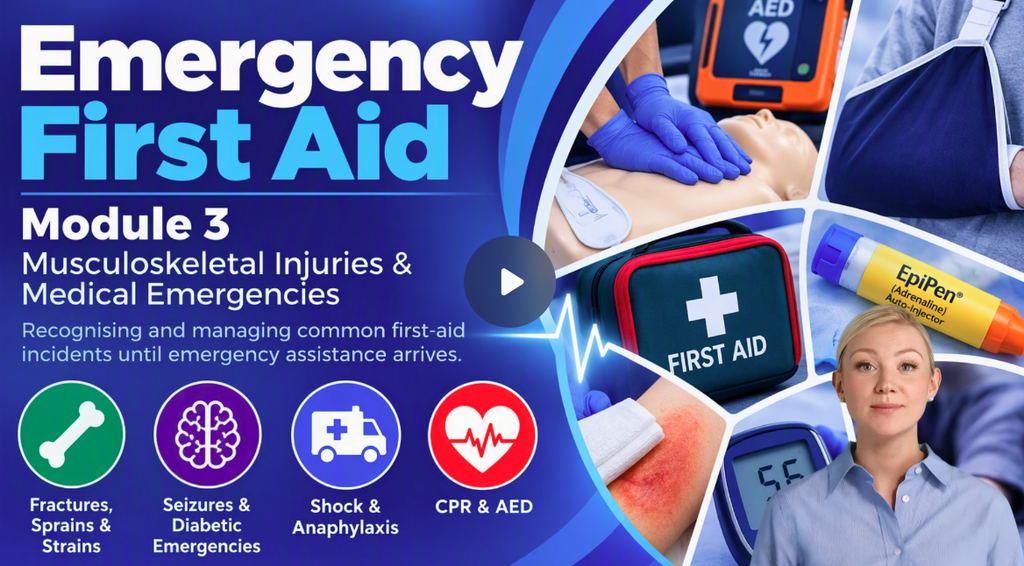
Module 3 Emergency First Aid – Musculoskeletal & Other Common Medical Emergencies
In person practical session which then focuses on a short recap then putting that knowledge into practice and covers the physical elements of first aid, including choking, CPR, bandaging and the recovery position, alongside the other practical elements of the course.
An expression-of-interest process will also help identify demand and coordinate training across the University.
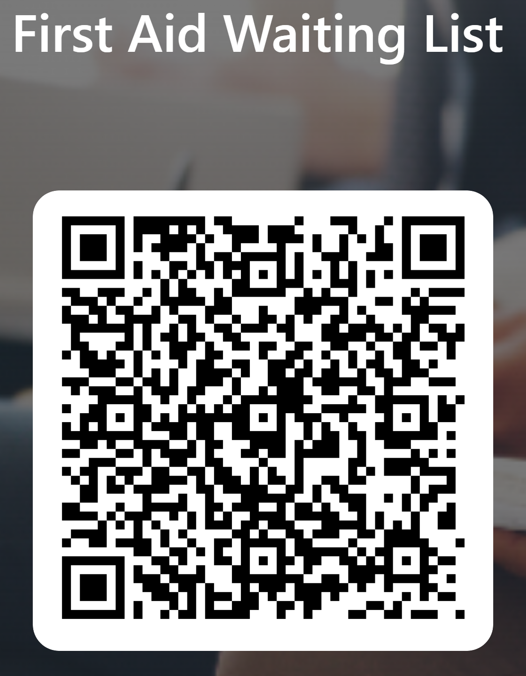
First Aid Waiting List – Fill in form or scan the QR Code.
Please refer to the First Aid Flowchart to assist with basic first aid requirements.
What is an accident and near miss
An accident is an unplanned event that that results in injury or ill health (even damage to equipment and property).
A near miss is an event not causing harm but has the potential to cause injury or ill-health.
Why is it important to report and record accidents, incidents & near misses?
Firstly, it raises awareness about safety issues. If an accident occurs in the workplace, reporting it and recording it allows the University to learn from the incident so something of the sort will not happen again. The incident can be an opportunity to hold a briefing in order to clear up any confusion about the safest and best way to perform work tasks.
All staff are encouraged to report incidents irrespective of how trivial they may appear as without this information; we are unable to effectively manage risk
The following link provides guidance on why and how we should report incidents.
Accident & Incident Recording with Investigation Process Operating Procedure
Information to consider during and after an Accident / Incident
Blank contacts board (naming first aiders)
Locations of automated external defibrillators (AEDs)
Lakeside Campus also has a defibrillator located in the office.
Using AEDs
The Resuscitation Council UK guidance on AEDs is that this equipment is safe to use and can be readily used by untrained bystanders., however, should you wish to understand more about the use of a AED please click the video below provide by the St John Ambulance
RevivR – Learn the steps of CPR – provided by British Heart Foundation.
RevivR is the 15-minute mobile training that shows you when and how to do CPR to save someone’s life. All you need to practise is a cushion.
Auto Injectors (Epi-pens)
Managing-Allergies-at-University-Booklet.pdf
Auto-Injectors (Epi-pens) In2012the Medicines Act was broadened to state that any lay person can administer adrenalin to save a life.
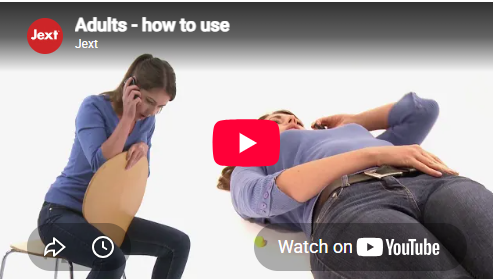
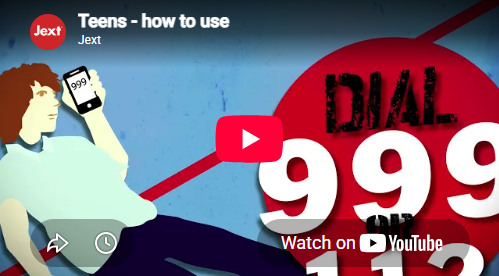
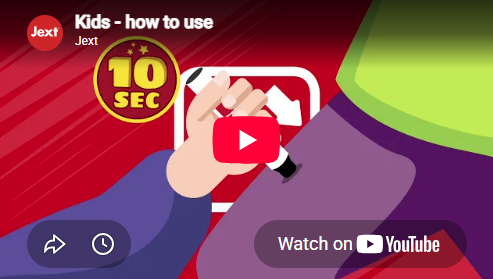
Medications: Guidance for Staff & Students Using Injectable Safety and Disposal
What To Do If Someone Has A Seizure – First Aid Training – St John Ambulance
A St John Ambulance trainer demonstrates what to look for if someone is having a seizure, what causes a seizure and what to do to help.
Diabetic Emergencies
In diabetes, “hypo” refers to hypoglycemia, or low blood sugar, and “hyper” refers to hyperglycemia, or high blood sugar. Both conditions can be dangerous if not managed properly.
The video provided by St Johns Ambulance provide how to support people when they have a high or low blood sugars.
RIDDOR
RIDDOR is the Reporting of Injuries, Diseases and Dangerous Occurrences Regulations 2013. These Regulations require the university to report specified workplace incidents
RIDDOR only requires you to report deaths and physical injuries in relation to accidents, including those involving acts of non-consensual violence
Who should report?
Only ‘responsible persons’ including employers, the self-employed and people in control of work premises should submit reports under RIDDOR
Examples of reportable and non-reportable injuries are available here
Medical Fridges
Some colleagues from time to time be in a position where they require medications or medical devices which require refrigerated storage. Therefore, maintaining a continuous power supply is essential. This sign provides a clear visual reminder not to unplug or switch off the refrigerator. Medical Fridge Sign.

First Aid Kits
It is the responsibility of Schools and departments to ensure first aid kits are maintained and available. They will need to arrange for kits to be replenished by purchasing through their own cost centre. The links below provide guidance on items / quantities that should be considered however you are free to include other items where there is a risk for example, burn cream in labs or where there is a risk of burns etc
Monitoring First Aid Kits
This checklist can be used to ensure that first aid kits are suitably stocked. This is a suggested minimum contents list.
First aid needs assessment
HSE do not tell you what provision you should make for first aid – First aid provision must be ‘adequate and appropriate in the circumstances’. This means we must provide sufficient first aid equipment (first aid kit), facilities and personnel at all times.
In order to decide what provision you need in the school or department you should undertake a first-aid needs assessment. This assessment should consider the circumstances of your workplace, workforce and the hazards and risks that may be present. The findings will help you decide what first-aid arrangements you need to put in place.
Ordering First Aid Supplies
When it’s identified that First Aid Suppliers require replenishing please contact the following:
Reliance Medical – General First Aid Supplies
WMS Ltd t/a Sp Service (UK) Ltd – First Aid Kits
St Johns Ambulance – First Aid Kits and Supplies
Banner – First Aid Kits and Supplies